

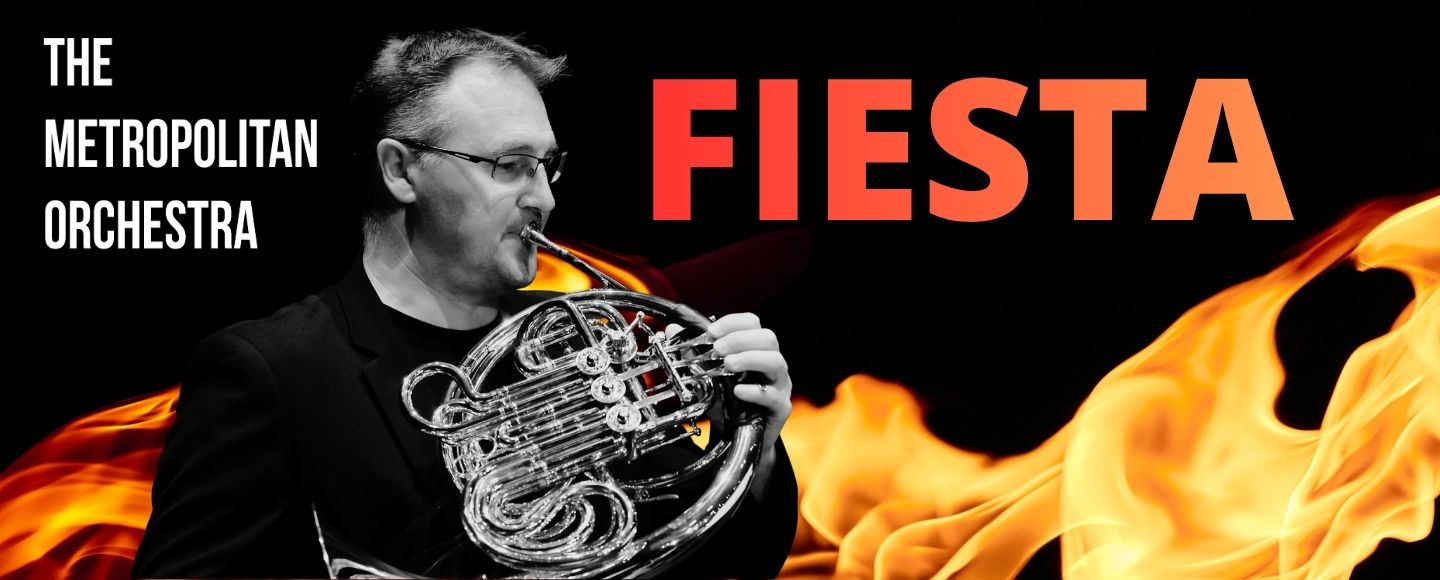
Sat 26 September 2026 7:00 pm
Program: Arturo Márquez – Danzón No. 2 Aram Khachaturian – Masquerade Suite Sergei Rachmaninoff – Symphonic Dances Conductor: Sarah-Grace Williams Venue: Verbrugghen Hall, Sydney Conservatorium of Music, 1 Conservatorium Road, Sydney NSW 2000Acknowledgment Of Country
The Metropolitan Orchestra acknowledges the traditional Aboriginal custodians of the land.
We acknowledge this is a country in which the members and elders of the local Aboriginal communities have been custodians for many centuries, and on which these people have performed age-old ceremonies.
The Metropolitan Orchestra acknowledges and pays our respects to the Gadigal, Wangal and Dharug peoples of the Eora Nation, the traditional custodians of this land on which we perform, and we pay our respects to all Elders both past and present.
Supported by Inner West Council
| Márquez, Arturo (1950 – ) | Danzόn No. 2 |
“The idea of writing the Danzón 2 originated in 1993 during a trip to Malinalco with the painter Andrés Fonseca and the dancer Irene Martínez, both of whom [have] a special passion for the danzón, which they were able to transmit to me from the beginning, and also during later trips to Veracruz and visits to the Colonia Salon in Mexico City. From these experiences onward, I started to learn the danzón’s rhythms, its form, its melodic outline, and to listen to the old recordings by Acerina Mariano Merceron and his Danzonera Orchestra. I was fascinated and I started to understand that the apparent lightness of the danzón is only like a visiting card for a type of music full of sensuality and qualitative seriousness, a genre which old Mexican people continue to dance with a touch of nostalgia and a jubilant escape towards their own emotional world; we can fortunately still see this in the embrace between music and dance that occurs in the State of Veracruz and in the dance parlors of Mexico City. Danzón 2 endeavours to get as close as possible to the dance, to its nostalgic melodies, to its wild rhythms, and although it violates its intimacy, its form and its harmonic language, it is a very personal way of paying my respects and expressing my emotions towards truly popular music.”
– Arturo Márquez
| Khachaturian, Aram (1903-1978) | Masquerade Suite |
Composed in 1941 from music originally written for Mikhail Lermontov’s drama Masquerade, Aram Khachaturian’s Masquerade Suite is one of the composer’s most popular orchestral works. The suite captures the glamour, passion, and underlying tragedy of a high-society world in which appearances conceal darker truths. Drawing on the rich melodies and vivid orchestral colours for which Khachaturian is renowned, the five movements form a sequence of contrasting character pieces.
The celebrated opening Waltz is the suite’s best-known movement. Sweeping and elegant, it evokes the splendour of an aristocratic ballroom while hinting at the drama and intrigue beneath the surface. A sense of grandeur is balanced by an unmistakable tension, reflecting the emotional conflicts at the heart of Lermontov’s play.
The energetic Mazurka follows, full of rhythmic vitality and bright orchestral textures. In contrast, the Romance offers a moment of lyrical tenderness, its expressive melodies revealing a more intimate and vulnerable side. The playful Galop introduces wit and sparkle, providing a burst of exuberant motion.
The suite concludes with the Waltz’s emotional spirit lingering in memory, leaving a bittersweet impression. Throughout the work, Khachaturian’s gift for melody and colourful orchestration shines brilliantly, creating music that is at once theatrical, evocative, and irresistibly engaging.
© Andrew Doyle 2026
| Rachmaninoff, Sergei (1873-1943) | Symphonic Dances, Op. 45 |
Following a gruelling concert season in 1940, in which Rachmaninoff performed 41 times, he was on holidays at a waterfront estate in Long Island, USA. Upon completion of the piano score, Rachmaninoff wrote to Eugene Ormandy, conductor of the Philadelphia Orchestra:
“Last week I finished a new symphonic piece, which I naturally want to give first to you and your orchestra. It is called `Fantastic Dances.’ I shall now begin the orchestration. …
I should be very glad if, upon your return, you would drop over to our place. I should like to play the piece for you.”
The Symphonic Dances was Rachmaninoff’s last major orchestral work and takes the form of a three movement symphony. The first movement opens with a driving rhythmic motive, propelled by restless energy and tempered by a lyrical, melancholy theme that reflects Rachmaninoff’s distinctive Russian voice. The most unique colour used in this work is the folk melody performed by a rare guest to the classical orchestra, the alto saxophone.
An unconventional waltz follows, elegant yet unsettling, conjuring a ballroom seen through the haze of memory. Graceful dance rhythms are coloured by darker harmonies, creating an atmosphere of romance and unease. The finale forms the work’s emotional climax, setting the ominous Dies Irae chant against a radiant Orthodox hymn. Their dramatic conflict ends in a triumphant affirmation, crowning the work as a fitting artistic farewell.
© Andrew Doyle 2026
The Metropolitan Orchestra – Click Here To Read TMO’s Biography.
Artistic Director and Chief Conductor Sarah-Grace Williams. Click Here To Read Sarah-Grace’s Bio.
This Evening’s Musicians
Concert Master: ^Victoria Jacono-Gilmovich
First Violin: *Dominic Meagher, Caroline Kelly, Elena Tabolkina, Anna Hansen-Smith, Greta Lee, Fiona Warren, Amanda Scott, Naomi Warr, Sarah Qiu, Ela Stopa-Zbikowska
Second Violin: *Dominique Guerbois, Katherine Finch, Sarah Anthony, Alexis Bell, Katrina Papallo, Jennifer Mee, Victoria Giles, Denisa Smeu-Kirileanu, Kimberley Santos, Joshua Kok
Viola: *Robyn Botha, Monique Turner, Haemi Lee, Jane Silcock, Charlie Brown, Liz D’Olier, Kirsten James, Dawid Botha, Alexandra Arkapaw
Cello: *John Benz, *Ezmi Pepper, Julienne Guerbois, Mitchell Quinn, Catherine Upex, Lye Lin Ho, Karen Cortez, Sally Schinckel-Brown
Bass: *Jeremy Fox, *Mark Szeto, Jessica Holmes, George Machado, Paignthor Acevedo-Martin
Flute: *Emilia Antcliff, Merryl Neille, Jacinta Mikus
Oboe: *Alex Fontaine, Caitlin Heathcote, Matt Bubb
Clarinet: *Andrew Doyle, ^Alisha Coward, Morgan Lacey
Bassoon: *Peta Goh, Nicholas Zengoski, Lyndon Coward
French Horn: *Adrian Hallam, Robert Stonestreet, Sarah Bernard, Oliver Harris
Trumpet: *Raphael Harvey, Harvey De Koster, Toby Rands
Trombone: *Gareth Lewis, Mark Brown, Harry Macpherson
Tuba: *James Barrow
Timpani: *Murray Parker
Percussion: *Selina Laugeon, Kaylie Dunstan, Anita Cook, Chiron Meller, Helen Parker
Harp: *Kaela Phillips
Piano: *Bev Kennedy
Saxophone: *Jeremy Choi
#Concert Master * Principal ^Associate Principal
Click here for a list of musicians who regularly perform with The Metropolitan Orchestra
The Metropolitan Orchestra is a not-for-profit arts organisation and a registered charity.
Consider making a tax-deductible donation to The Metropolitan Orchestra and join us in shaping the future of music in Australia. Every donation, no matter the size, makes a tangible difference. Your support ensures that TMO continues to bring world-class music to audiences of all ages, foster the next generation of musicians, and create a thriving arts landscape in Australia.
All donations over $2.00 are Tax-Deductible. We sincerely thank you for your support.